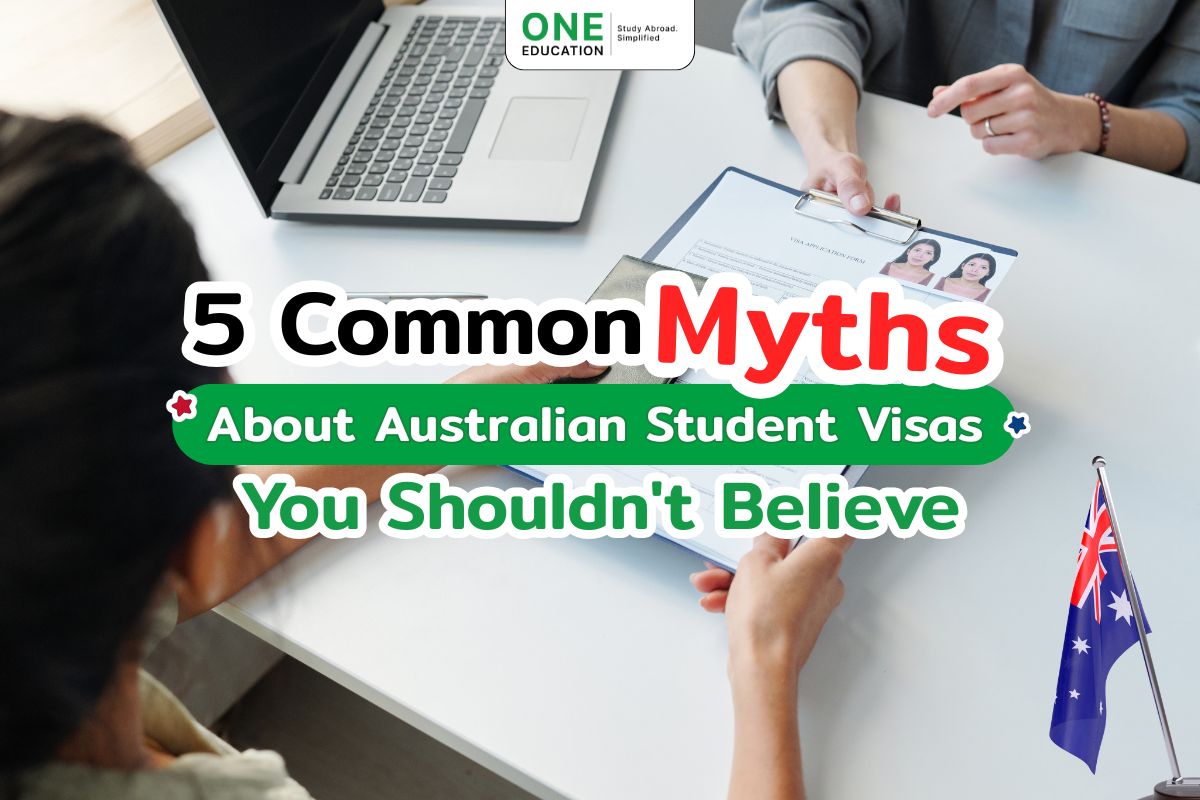
5 Common Myths About Australian Student Visas You Shouldn’t Believe
- Study Australia Tips | Study Australia Tips
- June 12, 2026
- One Education
Studying in Australia can sometimes seem incredibly easy, while for others it can feel surprisingly difficult. Some people believe that having enough money is all it takes to get there. However, misconceptions about studying in Australia often lead students to prepare poorly or submit incomplete documents, turning what could have been a straightforward process into a complicated one. Before deciding to study in Australia, it is important to understand the student visa process and determine whether Australia is truly the right destination for you. In this article, One Education shares 5 common myths about Australian Student Visas that many people still misunderstand.
1. Australian Student Visa holders can work unlimited hours and do any job

Myth: Australian Student Visa (Subclass 500) holders can work unlimited hours during both term time and holidays, can take any type of job, and can switch between multiple employers without restrictions.
Fact: Students holding an Australian Student Visa (Subclass 500) can work up to 48 hours per fortnight during study periods and can only begin working from the official start date of their course. During official holidays, students may work unlimited hours. Changing employers does not provide additional working hour allowances. The 48-hour limit per fortnight applies across all jobs combined. It is also important to remember that the Student Visa only permits part-time work while studying, not full-time employment.
2. Having enough money guarantees an Australian Student Visa

Myth: As long as there is a large amount of money in the bank account, obtaining an Australian Student Visa is easy and other documents are not particularly important.
Fact: Having sufficient funds does not automatically guarantee a student visa. Applicants must prepare and submit all required documents correctly and completely. This includes: Providing accurate and consistent information, Completing a medical examination at an approved clinic, Attending Biometrics Collection appointments, and Uploading supporting documents that match the information provided in the Genuine Student (GS) statement. Every stage of the process must be completed correctly. Financial evidence is only one component of the Australian Student Visa application.
3. Choosing a simple and inexpensive course makes it easier to get a visa
Myth: Applying for an easy course below degree level, such as an English language programme, or choosing a low-cost institution makes it easier to obtain a visa because the goal is simply to get to Australia.
Fact: Australian immigration authorities place significant emphasis on the Genuine Student (GS) requirement. The GS assessment is designed to confirm that students genuinely intend to study in Australia, have a clear education plan, and possess sufficient financial support. The assessment focuses on questions such as: How will the course benefit the student?, How does the course align with future career plans?, Why was this particular institution selected?, Is the institution properly accredited? Choosing a low-cost school or language programme does not necessarily improve visa prospects. The quality and relevance of the programme are often more important than the tuition fee.
4. Any course can easily lead to Permanent Residency (PR)
Myth: Students can study any programme, graduate, and then easily apply for Permanent Residency (PR) without considering their field of study or English language results.
Fact: Completing any course does not automatically qualify someone for Permanent Residency. Applicants generally need to: Graduate in an occupation that appears on Australia’s Skilled Occupation List, Meet Skilled Migration visa requirements, Accumulate sufficient points through the Points Test, Gain relevant work experience, Meet English language requirements, Educational qualifications, English proficiency, work experience, and other factors all contribute to PR eligibility. There is no automatic pathway simply through graduation.
5. Being onshore makes it easy to switch visas

Myth: Once students are already in Australia, changing to another visa type becomes easy, regardless of the reason.
Fact: Australian immigration authorities have become increasingly strict and focus heavily on the purpose behind any visa change. If students wish to extend or change their course, authorities will assess whether the new programme represents academic progression. For example, continuing to study at the same academic level repeatedly may create concerns that the applicant is remaining in Australia longer than necessary. Applications that do not demonstrate a clear academic progression pathway may face higher risks of refusal.
Interested in Studying in Australia?
For more information and assistance with the application process, please contact One Education, an official representative of leading Australia universities. We offer free consultation and support throughout your application journey.
Add our Line official account: @one-edu
Submit an enquiry form. We will get back to you as soon as possible.
Call us: 02-652-0718
One Education | Study Abroad. Simplified
Follow Us
Facebook: One Education
Instagram: oneeducationthailand
Twitter: One Education
TikTok: oneeducationthailand
YouTube: One Education
Latest Blogs
University of Nottingham Scholarships 2027 University of York Scholarships 2027 Loughborough University Scholarships 2027 Newcastle University Scholarships 2027 Scape Student Accommodation in Australia: Student Housing Near Top UniversitiesCategories
Student Diary
Study UK Tips
Study Australia Tips
Popular Courses
Scholarships
English Promotions