UNSW College Applied Degrees: Explore 3 Practical Bachelor’s Degrees in Australia

- Study Australia Tips | Study Australia Tips
- September 15, 2026
- One Education
For students looking to study a bachelor’s degree in Australia and seeking more than traditional classroom-based learning, UNSW College Applied Degrees are an exciting option to consider. These programs are designed to help students develop both academic knowledge and practical skills that can be applied in real-world work environments from the very beginning of their studies.
UNSW College Applied Degrees emphasise hands-on learning through Real-world Projects, Industry-designed Projects, and industry-based challenges. Students also have the opportunity to undertake an Industry Placement, giving them valuable real-world work experience before graduation.
Currently, UNSW College offers Applied Degrees across three key areas: Bachelor of Applied Business (Business Management), Bachelor of Information Technology (Software Development), and Bachelor of Information Technology (Cyber Defence and Networking).
In this article, the One Education team takes a closer look at all three UNSW College Applied Degrees, including what you will study, tuition fees, and potential career opportunities after graduation. This will help you determine whether an Applied Degree at UNSW College is the right choice for your study and career goals.
1. Bachelor of Applied Business (Business Management)

The Bachelor of Applied Business (Business Management) at UNSW College is a bachelor’s degree designed to take a different approach from traditional Business programs. Instead of focusing primarily on theory, the program emphasises applying business knowledge to real-world situations from the very beginning of the degree.
The program combines Business Knowledge, Leadership, Strategic Thinking, Data Analytics, and Digital Skills, while giving students opportunities to work on real business challenges and learn from Industry Professionals.
Over the three-year program, students develop both business knowledge and the practical skills needed to succeed in modern organisations. Real-world Projects, Industry Engagement, and Structured Industry Placement are integrated into the learning experience.
Key Features of the Bachelor of Applied Business
1. Hands-on Learning from Day One
Students continuously apply their knowledge to real-world business challenges. Each term includes Industry-designed Projects, using project briefs and data from real companies as part of the learning experience.
2. No Traditional Exams
Assessment focuses on Practical, Collaborative, and Scenario-based Assessments, allowing students to demonstrate their skills through teamwork, problem-solving, and practical applications rather than relying primarily on traditional exams and memorisation.
3. Learn Business Tools Used in the Workplace
Students don’t just learn Business Theory. They also develop practical skills using tools and software commonly used in real workplaces, including MYOB, Xero, Microsoft Excel, Power BI, and Digital and Business Systems.
The program places particular emphasis on using Data and Digital Tools to analyse information and support business decision-making, essential skills for today’s Business Professionals.
What Skills Will You Gain from a Bachelor of Applied Business at UNSW College?
- Leadership & Management – Learn how to manage teams, motivate people, manage change, and make decisions in rapidly changing business environments.
- Strategic Thinking – Develop the ability to analyse business challenges, develop strategies, and design approaches that support organisational growth.
- Data-informed Decision Making – Learn how to interpret data and use Data Analytics and Digital Tools to turn information into actionable Business Insights.
- Professional Communication – Develop Written, Oral, and Digital Communication skills, including communicating effectively with stakeholders from different cultural backgrounds.
- Digital & Operational Skills – Develop practical skills in systems and software commonly used in modern organisations.
Examples of Key Subjects
- Creating Value through Marketing
- Data Insights for Business Decision Making
- Business Analytics for Decision Making
- Strategic Business Analysis
- Managing and Leading Across Cultures
Potential Career Opportunities
Graduates may pursue careers in a range of business-related roles, including:
- Business Analyst
- Business Manager
- Financial Planner
- CRM Officer
- Operations Manager / Assistant
- Project Manager
- Governance Officer
Duration: 3 years
Intakes: March and October
Indicative Entry Requirements:
- Mathayom 6 with a minimum GPA of 2.5
- IELTS Overall 6.5, with no less than 6.0 in Writing
2027 Tuition Fee: AUD 34,080 per year, approximately THB 817,920 per year*.
2. Bachelor of Information Technology (Software Development)
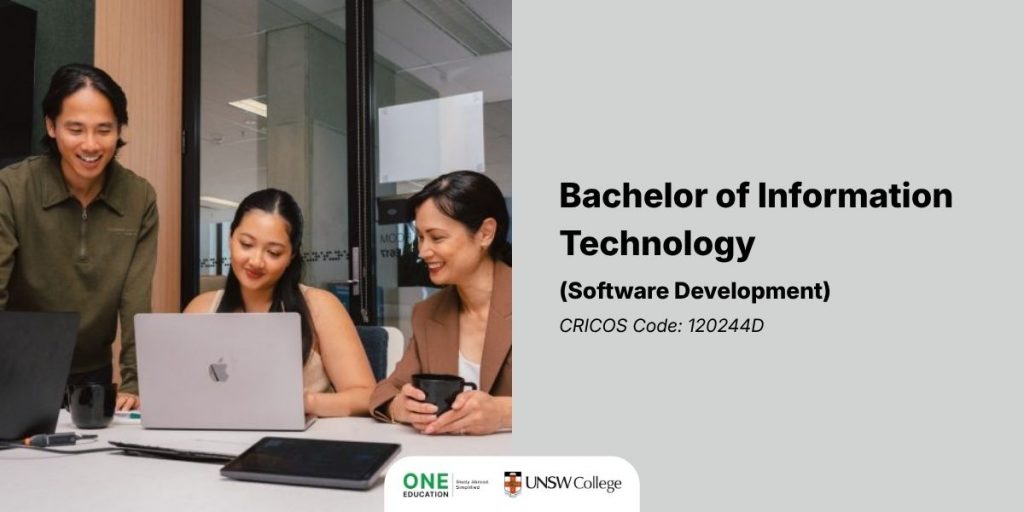
The Bachelor of Information Technology (Software Development) at UNSW College is designed for students who want to pursue careers in Software Development and Digital Technology, with a strong focus on practical learning and applying technical skills to real-world situations.
The program covers a broad range of areas, including Programming, Databases, Cloud Computing, Artificial Intelligence (AI), Machine Learning, Mobile Application Development, Software Engineering, and Systems Design.
Students learn through Hands-on Projects, Industry-designed Projects, and Workplace Learning, with opportunities to undertake an Industry Placement and apply their technical skills in a real workplace environment before graduation.
Key Features of the Bachelor of Information Technology (Software Development)
1. Learn Programming and Software Development Through Hands-on Practice
Students develop a strong foundation in Programming and practise building software through Practical Exercises and Coding Projects.
The Programming Fundamentals subject helps students develop skills in Problem Solving, Algorithmic Thinking, and Coding, while Applied Programming builds on these foundations by introducing Web Application Development, including Validation, Testing, and Debugging — essential processes in professional software development.
2. Learn AI and Machine Learning
Artificial Intelligence is another key component of the program. Students explore topics ranging from Artificial Intelligence Fundamentals to Machine Learning and Natural Language Processing (NLP).
They also learn how AI and Machine Learning can be applied to develop Software and Digital Solutions.
3. Develop Cloud Computing Skills and Scalable Systems
Cloud Technology is an increasingly important skill for modern Software Developers. The program includes subjects such as Cloud Computing and Secure Cloud Network Architecture.
Students develop an understanding of how to design and develop Cloud-based Applications, as well as how to build systems that can scale to support larger numbers of users.
4. Learn Software Engineering Through Real-world Practices
Students explore the Software Development Lifecycle, from problem analysis and system design to application development and testing.
They also develop essential technical skills including Software Design, System Architecture, Testing, Debugging, Version Control, Agile Development, and Problem Solving. These skills help students understand how professional Development Teams work, rather than focusing solely on Coding.
What Skills Will You Gain from a Bachelor of Information Technology (Software Development)?
- Programming & Coding – Learn programming fundamentals and progress towards developing more complex software while strengthening Problem-Solving and Algorithmic Thinking skills.
- Artificial Intelligence – Explore AI fundamentals, Machine Learning, and Natural Language Processing, as well as the development of AI Solutions.
- Cloud Computing – Understand Cloud Technologies and learn how to design Applications that operate in Cloud Environments.
- Database Management – Learn how to design and manage Databases, including Data Modelling, Normalisation, and SQL.
- Software Engineering – Learn systematic approaches to Software Development, from Design and Development through to Testing and Maintenance.
- Cybersecurity Fundamentals – Although the program focuses on Software Development, students also study Foundations of Cyber Security in their first year, developing an understanding of Threats, Vulnerabilities, Risk, and IT Security.
- Communication & Leadership – In addition to Technical Skills, students develop Digital Communication and Reflective Leadership in Action skills to work effectively with both Technical and Non-technical Teams.
Examples of Key Subjects
- Object-Oriented Programming (OOP)
- Artificial Intelligence / Machine Learning (AI/ML)
- Software Engineering
- Natural Language Processing (NLP)
Potential Career Opportunities
Graduates may pursue careers in a range of technology roles, including:
- Software Developer
- Web Developer
- Application Developer
- AI / Machine Learning Engineer
- AI Solutions Specialist
- Cloud Application Developer
- DevOps Engineer
- Data Scientist / Data Analyst
Duration: 3 years
Intakes: March and October
Indicative Entry Requirements:
- Mathayom 6 with a minimum GPA of 2.5
- IELTS Overall 6.5, with no less than 6.0 in Writing
2027 Tuition Fee: AUD 34,080 per year, approximately THB 817,920 per year*.
3. Bachelor of Information Technology (Cyber Defence and Networking)
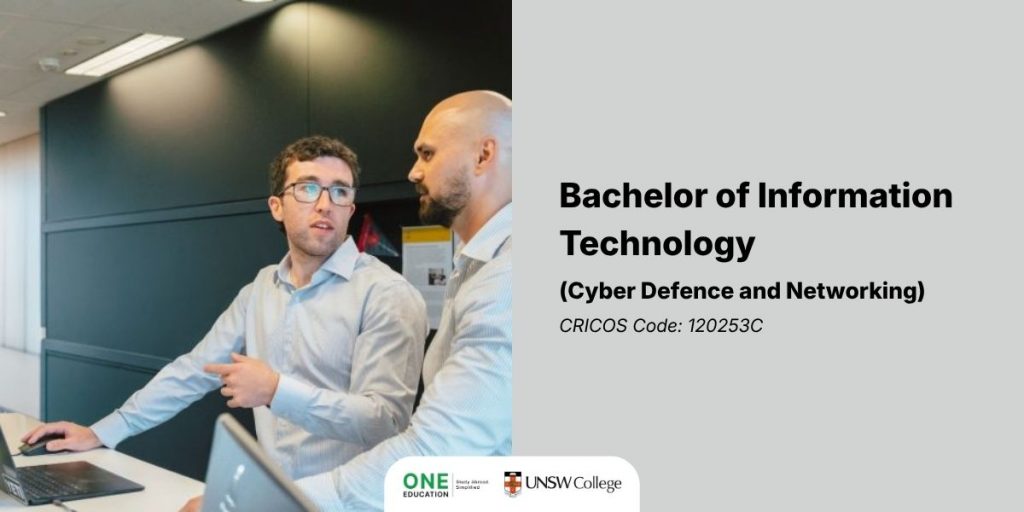
The Bachelor of Information Technology (Cyber Defence and Networking) at UNSW College is designed for students interested in Cybersecurity, Network Security, Cloud Technology, and protecting digital systems from Cyber Threats.
Students develop practical skills in Securing Networks, Detecting Intrusions, Analysing Security Incidents, and Responding to Cyber Threats through Hands-on Learning, Industry Projects, and Workplace Experience.
A key feature of the program is its industry-focused curriculum, which is designed in collaboration with industry professionals to ensure students develop skills and learn about tools relevant to real-world Cybersecurity and Networking roles.
Throughout the program, students gain knowledge across Cyber Defence, Networking, Cloud Technology, and IT Infrastructure, giving them a broad understanding of how modern IT systems are designed, managed, and protected.
Key Features of the Bachelor of Information Technology (Cyber Defence and Networking)
1. Learn Cybersecurity Through Hands-on Learning from the First Term
One of the key features of the program is Practical Learning from the First Term. Students work on Applied Projects throughout their studies, using data, tools, and challenges inspired by real-world industry scenarios.
This allows students to gradually develop their Technical Skills while building a Professional Portfolio alongside their academic studies.
2. Practise Through Simulated Cyber Operations
Students have the opportunity to respond to Cyber Threats through Simulated Cyber Operations in a controlled learning environment.
This approach allows students to practise skills ranging from Vulnerability Assessment to Threat and Security Incident Response, without having to wait until they enter a real workplace to gain practical experience.
3. Study Cybersecurity, Networking and Cloud Technology
The program goes beyond Cybersecurity to cover Networking and Cloud Technologies, which are essential components of modern IT systems. Students learn how to Design, Configure, and Defend different types of environments, including On-premise, Cloud, and Hybrid Environments.
This helps students develop a broader understanding of IT Infrastructure and how to protect systems across different environments, from the Network layer through to the Cloud.
What Skills Will You Gain from a Bachelor of Information Technology (Cyber Defence and Networking)?
- Cyber Defence – Learn how to protect IT systems from Cyber Threats, identify Vulnerabilities, and apply Security Frameworks to build secure and resilient systems.
- Networking – Develop knowledge from Network fundamentals through to designing and managing Network Infrastructure, including Network Security.
- Cloud Security – Understand Cloud and Hybrid Infrastructure and learn approaches to securing systems operating in Cloud Environments.
- Threat Detection & Incident Response – Develop skills in analysing Security Alerts, investigating Incidents, and responding to Cyber Threats within IT systems.
- Security Monitoring – Learn about tools and practices related to Security Monitoring, Governance, and system assessment.
- Programming – Although the program focuses on Cyber Defence and Networking, students also develop Programming and Software Development skills to understand how systems work and build Software Applications.
Examples of Key Subjects
- Cloud Computing
- Cyber Security Operations
- Assurance and Vulnerability Management
- Secure Cloud Network Architecture
- Cyber Security Policy and Procedure
Potential Career Opportunities
Graduates may pursue careers in a range of Cybersecurity and IT-related roles, including:
- Cybersecurity Analyst
- Cloud Architect
- IT Security Consultant
- IT Support Specialist
Duration: 3 years
Intakes: March and October
Indicative Entry Requirements:
- Mathayom 6 with a minimum GPA of 2.5
- IELTS Overall 6.5, with no less than 6.0 in Writing
2027 Tuition Fee: AUD 34,080 per year, approximately THB 817,920 per year*.
Are Scholarships Available for UNSW College Applied Degrees?
Students applying for UNSW College Applied Degrees and planning to commence their studies in 2027 may be eligible to apply for the Applied Leadership Award, which offers a tuition fee reduction of up to AUD 10,000 per year.
The scholarship is limited and awarded based on the applicant’s academic performance, achievements, and overall suitability.
Applicants are generally required to:
- Submit a 500-word Personal Statement explaining their reasons and motivation for choosing an UNSW College Applied Degree.
- Provide a Resume/CV highlighting their previous experience, achievements, and activities.
- Scholarships are limited, and recipients are selected based on their academic performance and individual merit.
Scholarship information and eligibility requirements may change. Please contact the One Education team for the latest information.
Frequently Asked Questions
💬 How Long Does It Take to Complete an UNSW College Applied Degree?
All three Applied Degree programs are 3 years in duration, with two intakes per year: March and October. UNSW College Applied Degrees do not rely on traditional examinations. Instead, students are assessed through Applied and Project-based Assessments.
The programs also include Structured Professional Practice in Year 2 or Year 3, as well as an 8-week Capstone Project during the final year, giving students opportunities to apply their knowledge and skills to practical projects.
💬 How Much Do UNSW Applied Degrees Cost?
For 2027, tuition fees for all three UNSW College Applied Degree programs are AUD 34,080 per year, equivalent to approximately THB 817,920 per year*.
💬 What Are the Entry Requirements for UNSW College Applied Degrees?
For Thai students, the general entry requirements include:
- Mathayom 6 qualification
- GPA of 2.5 or above
- IELTS Overall 6.5, with a minimum 6.0 in Writing
If you are still unsure which UNSW College Applied Degree best matches your interests and future career goals, you can contact the One Education team for guidance. Our team can help you compare programs and career pathways, as well as assist with your university application completely free of charge.
* The tuition fees above are based on an exchange rate of AUD 1 = THB 24. Tuition fees and entry requirements are subject to change.
Interested in Studying at UNSW College?
For more information and assistance with the application process, you can contact One Education, an official representative of Australian Universities. We offer free consultation and support throughout your application journey.
Add our Line official account: @one-edu
Submit an enquiry form. We will get back to you as soon as possible.
Call us: 02-652-0718
One Education | Study Abroad. Simplified
Follow Us
Facebook: One Education
Instagram: oneeducationthailand
Twitter: One Education
TikTok: oneeducationthailand
YouTube: One Education
Latest Blogs
University of Nottingham Scholarships 2027 University of York Scholarships 2027 Loughborough University Scholarships 2027 Newcastle University Scholarships 2027 Scape Student Accommodation in Australia: Student Housing Near Top UniversitiesCategories
Student Diary
Study UK Tips
Study Australia Tips
Popular Courses
Scholarships
English Promotions